Here's something I've been thinking about a lot lately.
We spend so much time and energy reading ingredient labels, researching "clean" nail polishes, hunting down non-toxic formulas, and vetting every product that touches our bodies. And that is genuinely important. Knowing what's in your products matters. I'm not here to downplay that.
But here's what I've come to believe after years in the beauty industry and building a brand specifically around protective practices: the products you choose are only half the story. The other half is what you actually do during your beauty routine.
Clean beauty isn't just what you put on your body. It's how you take care of your body in the process of beautifying it. And nowhere is that distinction more visible, or more overlooked, than in the gel manicure.
The Clean Beauty Movement Got Something Right (And Something Incomplete)
The clean beauty movement changed the conversation in a profound way. It told consumers: you have the right to know what is in your products. It raised awareness about potentially harmful ingredients like formaldehyde, toluene, and dibutyl phthalate in nail polishes. It pushed brands to develop 3-free, 5-free, 10-free formulas. It created accountability where there previously was very little.
I believe in all of that. I support all of that.
But here is the gap the movement hasn't fully addressed: product formulation is only one source of beauty-related exposure. The other source is the process itself. The technique. The tools. The environment. What happens to your skin during a service, not just from a product applied to it.
You can book an appointment at the most meticulously "clean" nail salon in your city, choose a 10-free gel polish, ask about every ingredient, and still leave every single visit having exposed the skin on your hands to cumulative UVA radiation during the curing process. Not because of what was in your polish. Because of what wasn't protecting your skin while it cured.
That is a practice gap, not a product gap. And it's the gap I think the clean beauty world needs to talk about more.
What "Practicing" Clean Beauty Actually Looks Like
Clean beauty as a practice means extending the same thoughtful, informed, intentional care you give to product selection to every aspect of your beauty routine. It means asking not just "what is going onto my skin" but "what is happening to my skin during this process."
In practice, that looks like a few things.
1. Protecting your skin during UV and LED nail lamp curing
If you get regular gel manicures, shellac manicures, or dip-powder services that use UV or LED nail lamps, your hands are being exposed to UVA radiation with every curing cycle. Research published in Nature Communications confirmed that UV nail lamps cause measurable DNA damage to skin cells, even in short individual sessions. The risk compounds over time, over years of weekly or biweekly appointments, in ways that matter for long-term skin health, collagen integrity, hyperpigmentation, and skin cancer risk.
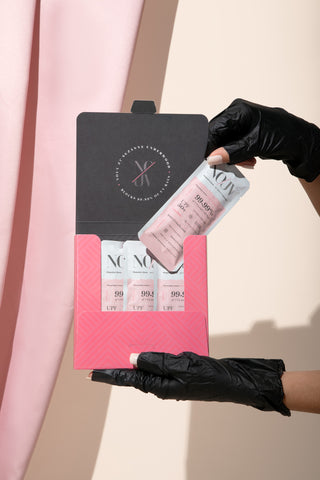
This is why I created NO/UV manicure gloves. Not because I wanted to add another product to the beauty market, but because I saw a genuine, under-addressed practice gap. Purpose-built, fingertipless UV-blocking gloves worn during the gel curing process provide 99.99% UVA and UVB protection for the skin on your hands, the area most directly and repeatedly exposed. They don't interfere with the service. The open fingertips mean your nails are fully accessible for polishing and curing. But the skin you live in every day of your life is shielded.
Choosing a clean nail polish formula while leaving your skin unprotected during curing is a little like buying organic food and then eating it off a chemically-treated surface. The product choice matters. And the practice has to keep up.
2. Treating your hands with the same skincare attention as your face
This one surprises people when I say it, but the skin on the back of your hands is thinner, more fragile, and more frequently exposed to UV radiation than almost any other part of your body. Hands age faster than faces, and they are almost always the thing people point to when they talk about looking older than they expected.
Clean beauty practices for your hands include: applying a broad-spectrum SPF 30 or higher to the dorsal surface of your hands as part of your daily skincare routine, using a deeply hydrating hand cream with antioxidants like vitamin C or niacinamide to support skin barrier function, and yes, wearing UV-protective manicure gloves at every gel nail appointment, whether at a salon or at home.
Your hands are doing extraordinary things every single day. They deserve extraordinary care. Not just through the products you choose, but through the protective practices you build.
3. Asking informed questions at every appointment
Clean beauty as a practice means being an advocate for your own health inside the salon, not just at the beauty counter. That means asking your nail technician whether the salon offers UV protective gloves for gel curing. Asking about ventilation and air quality. Asking whether tools are properly sterilized between clients. Checking whether the products being used on your nails are from reputable, professional brands with documented formulations.
These questions aren't demanding or excessive. They're the same level of informed engagement you bring to every other clean beauty decision you make. The nail appointment is part of your beauty and wellness practice. It deserves the same intention.
4. Being consistent, not just conscious
Here's something I've learned from building a brand in this space: awareness is the beginning, not the endpoint. I talk to women who know all about UV exposure from gel nail lamps. They've read the articles, they've seen the studies referenced on social media, they understand the cumulative risk. But they still don't protect their hands consistently at appointments, because protection wasn't built into the routine.
That's the thing about practices: they have to become habits to work. Knowing something is true isn't the same as building it into what you do every time. Keeping a pair of NO/UV gloves in your purse or in your at-home gel kit means protection is already there, built in, ready every time without requiring a separate decision in the moment.
Clean beauty practices don't have to be complicated. They just have to be consistent.
Why This Matters for At-Home Gel Manicures Too
The at-home gel manicure market has grown enormously over the past several years. Nail kits, professional-grade LED nail lamps, and gel polish systems designed for home use have put salon-quality gel nails within reach for millions of people who prefer the convenience, the cost savings, or simply the ritual of doing their own nails.
The at-home gel manicure is a wonderful thing. I love it. And it comes with the same UV exposure reality as the salon version, with one important difference: at home, you're the only one responsible for whether you're protecting your skin.
At a salon, there is at least the possibility that the technician, the establishment, or the environment prompts awareness. At home, it's just you, your gel kit, and your LED lamp. Which is exactly why building protection into your at-home gel nail routine from the very beginning is so important. Every time you cure. Both hands. Every coat.
Keeping NO/UV gloves in your nail kit next to your gel polish and your LED lamp is the kind of small habit shift that makes a meaningful long-term difference. It makes protection automatic, which is the only kind of protection that holds up over time.
The Bigger Picture: Whole-Body Beauty Wellness
I started NO/UV because I believe the clean beauty conversation has to expand beyond ingredient lists and product formulations. Those conversations are important and necessary. But they're incomplete if they don't also address what happens to skin during the beauty services we love.
True whole-body beauty wellness is about being as thoughtful about your practices as you are about your products. It's about recognizing that your nail appointments, your gel manicure routine, your skincare rituals, they are all opportunities to either protect or expose the skin you're in.
You've put real thought and real investment into choosing clean beauty products. You deserve a routine that protects you just as intentionally while you use them.
That's what NO/UV is about. Not fear. Not doom. Just the simple, informed decision to protect your skin during every gel manicure appointment, because you know it's cumulative, you know it matters, and you've decided your hands deserve the same thoughtful care as the rest of your wellness routine.
Start Here
If you're ready to bring the same intentionality to your nail care practices that you already bring to your product choices, here's where to begin.
-
At your next gel nail appointment, whether at a salon or at home, put on a pair of NO/UV fingertipless UV-protective manicure gloves before you cure. Note how simple it is. Note how it becomes routine almost immediately.
-
Add SPF to the backs of your hands every morning as part of your existing skincare routine. It takes four seconds and your hands will thank you for it in ten years.
-
Ask questions at your salon. A great salon welcomes informed clients. If yours doesn't, that's good information too.
-
Make protection a habit, not a one-time decision. Clean beauty practices work when they're built in, not just thought about.
Your gel manicure is one of the most personal, indulgent, confidence-building rituals in your self-care practice. It should also be one of the safest. The products and the practices together: that's what clean beauty actually looks like.
Stay polished. Stay protected.
Your beauty and your health are both in your hands.
Suzanne Underwood
Founder, NO/UV for Nails