I've sat in a lot of nail salons over the years. Some were immaculate, professional, and felt like true sanctuaries. Others (and I say this with love for the industry that inspired my entire business) had practices that gave me pause the moment I walked through the door.
When I was building NO/UV, I spent a lot of time thinking about what a truly safe, modern nail salon looks like. Not just from the perspective of UV protection, though that matters enormously and we'll get to it but from every angle that affects a client's health, hygiene, and overall experience. Because a gel manicure should be one of the most relaxing, indulgent things you do for yourself. Not something you walk away from wondering.
The truth is, most people don't know what questions to ask or what to look for. We hand over our hands, pick a color, and trust that the rest is handled. And while most nail salons are doing their best, the standards that separate a genuinely safe, modern salon from one that cuts corners are specific and worth knowing.
So I put together the checklist I wish I'd had. Whether you're finding a new salon, evaluating your current one, or heading in for your next appointment, here is exactly what to look for and what should send you in the other direction.
Why Nail Salon Safety Deserves More Attention Than It Gets
The nail industry in the United States generates over 8 billion dollars annually and employs close to 400,000 nail technicians. It's one of the most personal-care-intensive service industries we interact with, and one of the least scrutinized from a health and safety standpoint, at least from the client's perspective.
Inside a nail salon, both workers and clients are exposed to a range of potential health considerations: chemical vapors from polishes, removers and adhesives; bacteria and fungal risk from tools and surfaces that contact skin and nails; UV radiation from gel curing lamps; and dust particulates from filing and acrylic application. Research from the CDC's National Institute for Occupational Safety and Health (NIOSH) has documented chemical exposure levels including volatile organic compounds (VOCs) like toluene, formaldehyde, and methyl methacrylate in nail salon environments that warrant ongoing attention.
None of this is meant to frighten you away from salons. It's context for why the difference between a safety-conscious salon and a careless one genuinely matters and why knowing what to look for puts you in a position to make informed, empowered choices about your own self-care.
A great salon doesn't just make your nails look beautiful. It protects your health in the process. These two things should never be in conflict and in the best salons, they aren't.
The NO/UV Nail Salon Safety Checklist
Run through this checklist at your next appointment or use it to vet a salon before you even book.
1. Licensing & Credentials
The first thing to confirm is that the salon is operating legally. This sounds basic, but licensing compliance varies widely and a licensed salon has met minimum standards that an unlicensed one hasn't.
-
Visible salon license.
Every nail salon in the U.S. must hold a current state cosmetology or nail salon establishment license. It should be displayed prominently often near the front desk or reception area. If you don't see it, it's completely appropriate to ask. -
Individual technician licenses.
In most states, every nail technician must hold their own individual nail technician license. Don't be shy about asking to see it. A licensed tech has completed state-mandated training in sanitation, safety, and technique. Training hour requirements vary by state: California requires 400 hours, New York 250. But the principle is consistent: licensed means trained. -
Current, unexpired credentials.
Licenses need to be renewed. A license on the wall that expired two years ago is not a license. Check the date.
2. Cleanliness & Sanitation Protocols
Cleanliness in a nail salon goes beyond a tidy appearance. The critical distinction is between cleaning (removing visible dirt), sanitizing (reducing bacteria to safe levels), and sterilizing (eliminating all microorganisms). A truly safe salon understands and practices all three.
-
Tools are sterilized between clients.
Metal tools (nippers, cuticle pushers, nail clippers) must be sterilized after each use. The gold standard is an autoclave (a medical-grade sterilization device that uses pressurized steam). Hospital-grade EPA-registered disinfectant solutions are also acceptable. Tools should arrive at your station in a sealed pouch or visibly clean disinfectant solution and never sitting loose on a countertop between clients. -
Disposable tools are single-use.
Nail files, buffers, and orangewood sticks are porous, which means they cannot be effectively sterilized. They should be disposed of after each client or given to you to take home for personal use. If a file is pulled from a drawer and used on your nails after being used on another client, that's a hygiene red flag. -
Workstations are disinfected between clients.
All surfaces that contact skin, the nail table, the armrest, the drying station, should be wiped with an EPA-registered disinfectant between every client. You should be able to observe this happening before you sit down. -
Pedicure basins are properly cleaned.
Pedicure foot basins require a multi-step sanitation process: draining, cleaning with soap and water, and soaking with an EPA-registered disinfectant for at least 10 minutes between clients. Whirlpool jets and pipes require additional flushing protocols. This is one of the most commonly skipped sanitation steps, and one of the most important, given that water and warmth create ideal conditions for bacterial and fungal growth. -
Technicians wash hands before your service.
Hand hygiene is the foundation of safe nail services. Your technician should wash their hands with soap and water, not just hand sanitizer, before starting your appointment. Both NailKnowledge and the Cortiva Institute cite this as a non-negotiable standard of care.
3. Air Quality & Ventilation
This is one of the most overlooked aspects of nail salon safety and one of the most scientifically well-documented concerns. Published research involving nail salons across the United States and internationally has consistently found elevated levels of volatile organic compounds (VOCs) in salon environments, including toluene, formaldehyde, ethyl acetate, and methyl methacrylate (MMA). These compounds are released from nail polishes, gels, acrylics, and removers during normal salon operations.
OSHA guidelines specify that nail salons should have ventilation providing at least 25 cubic feet per minute of fresh outdoor air per person during business hours. NIOSH research has found that proper local exhaust ventilation can reduce worker chemical exposure by at least 50%. And yet, multiple studies have documented that many salons operate with inadequate ventilation, relying on open doors or ceiling fans rather than proper air exchange systems.
What this means for you as a client:
-
The salon doesn't have an overwhelming chemical smell.
A strong, persistent chemical odor, particularly of acetone, acrylic, or solvent, is a signal that VOC levels are elevated and ventilation is inadequate. A well-ventilated salon will have some scent, but it should not be suffocating. -
Windows are open or an active ventilation system is running.
Look for open windows, ceiling ventilation, or air purification units actively running. The best salons use local exhaust ventilation, downdraft tables that capture fumes at the source, directly at the nail station, rather than relying on general room air circulation. -
The salon uses lower-toxicity products where possible.
Ask whether the salon uses nail polishes and gels labeled as "3-free" (free from the toxic trio of toluene, formaldehyde, and dibutyl phthalate) or "5-free" and beyond. OSHA specifically cites these formulations as safer alternatives worth seeking out. Many modern, forward-thinking salons have made the switch to cleaner formulas without sacrificing quality or longevity. -
HEPA or activated carbon air purification is present.
The most effective air quality systems combine HEPA filtration (capturing fine particulates and dust) with activated carbon filtration (absorbing chemical vapors and odors). A salon that has invested in this technology is signaling that it takes indoor air quality seriously.
4. UV Protection During Gel Manicure Curing
You knew this one was coming and it's the section closest to my heart and the entire reason I founded NO/UV. If you're getting a gel manicure or shellac manicure, your hands will go under a UV or LED nail lamp to cure the polish. This is non-negotiable to the process. And without protection, every curing cycle is exposing the skin on your hands to UVA radiation.
The science is clear: UVA rays from gel nail lamps cause measurable DNA damage to skin cells, accelerate aging through collagen breakdown, trigger hyperpigmentation, and over cumulative exposures, increase skin cancer risk. A study published in Nature Communications confirmed these effects even with short individual exposures. Meaning the risk isn't about any single appointment, but about what accumulates over months and years of regular gel manicures.
A truly safe, modern salon accounts for this. Here's what to look for:
-
The salon offers UV-protective manicure gloves.
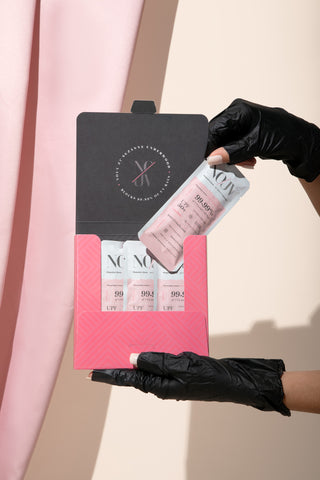
The gold standard is a salon that proactively offers clients UV protection before every gel curing cycle. Ideally, this means purpose-built, fingertipless UV-blocking manicure gloves, like NO/UV, that have been third-party tested to block 99.99% of UVA and UVB rays. These gloves are designed specifically for this application: open fingertips allow full access to the nails for polishing and curing, while the rest of the hand is completely shielded. -
If gloves aren't offered, bring your own.
If your salon doesn't provide UV protection, bring a pair of NO/UV gloves with you. Our disposable, single-use, fingertipless gloves are compact and purse-friendly, designed for exactly this purpose. Don't let a salon's oversight become your skin's problem. -
The salon uses modern, properly maintained curing lamps.
UV and LED nail curing lamps should be current-generation devices, regularly inspected, and free from cracked or broken lamp covers. Damaged housing can change the radiation pattern and increase incidental UV exposure to surrounding skin. -
The technician positions your hand correctly.
Proper nail lamp technique positions the fingernails, not the full dorsal surface of the hand, as the primary exposure surface. A skilled, safety-aware technician cures your nails efficiently and minimizes unnecessary curing time, reducing cumulative UV exposure.
If you walk into a salon and no one mentions UV protection during your gel service, you now know: that's a gap worth filling yourself. NO/UV gloves are small enough to keep in your purse for every appointment. Bring them. Use them. Your future skin will thank you.
5. The Products Being Used on Your Nails
You have every right to know what products are being applied to your nails and skin. In a transparent, professional salon, this question should be welcomed, not deflected.
-
Brand-name, professional-grade products are used.
Reputable salons use established, professional nail brands whose formulations are documented, regulated, and consistent. Be cautious of salons using unbranded or unlabeled products, or products purchased from unverified sources. -
Products are clearly labeled and stored properly.
Under OSHA's Hazard Communication Standard, nail salons are required to maintain Safety Data Sheets (SDS) for all potentially hazardous products used on-site. These documents detail ingredients, health hazards, and safety protocols. A compliant salon keeps these accessible. Chemical containers should be stored sealed when not in use, leaving acetone or solvent open in bowls between uses is both wasteful and increases VOC levels unnecessarily. -
The salon can tell you what's in their products.
Ask what nail polish, gel, top coat, and primer brands the salon uses. A salon that can answer clearly and confidently is a salon that knows its materials. One that is evasive or uncertain is a salon worth reconsidering. -
Lower-toxicity or HEMA-free gel options are available.
HEMA (hydroxyethyl methacrylate) is a common ingredient in gel polishes associated with allergic contact dermatitis in some clients. An increasing number of professional-grade gel brands now offer HEMA-free formulations. A salon staying current with product innovation is a salon invested in client health.
6. Professionalism, Communication & Client Care
The technical and hygiene markers above are measurable and observable. But the culture of a salon, how staff communicate, how questions are received, how clients are treated, is equally telling about whether a salon genuinely prioritizes your wellbeing or is simply going through motions.
-
Your questions are welcomed, not deflected.
A professional, confident salon has nothing to hide and welcomes informed clients. If asking about sterilization protocols, product ingredients, or UV protection is met with defensiveness, dismissiveness, or evasion, that tells you something important. -
The technician assesses your nail and skin health before starting.
A skilled nail technician will briefly examine your nails before beginning your service, checking for signs of infection, nail damage, or conditions that might affect the service. Starting a service on visibly compromised nails or skin without acknowledgment is a professional gap. -
There is no pressure to upsell services you don't need.
Trustworthy salons recommend services based on your actual needs, not upsell pressure. A good technician will tell you if your nails need a break, if a treatment isn't in your nail's best interest, or if something they observe warrants a dermatologist's attention. -
After-care guidance is provided.
A modern, client-focused salon will offer brief aftercare guidance: how to maintain your gel manicure between appointments, how to moisturize your cuticles, how to safely remove gel polish at home if needed. This is a mark of a salon that cares about your nails beyond the appointment itself.
Red Flags: When to Walk Out Before You Sit Down
I'd be doing you a disservice if I only gave you the positive checklist without being direct about the warning signs that should give you pause. Here are the red flags I'd act on immediately:
-
Tools come out of a drawer, not a sealed pouch or disinfectant.
This is the clearest signal that sterilization protocols are not being followed between clients. -
Strong, persistent chemical smell throughout the salon.
This indicates inadequate ventilation and elevated VOC levels, a health concern for you and especially for the workers who are there all day. -
No visible licenses posted. Operating without displayed, current licensing is both a regulatory issue and a red flag about overall professionalism.
-
The salon reuses disposable files or buffers.
Porous tools cannot be sterilized and must be single-use. Reusing them is an infection risk, full stop. -
No UV protection offered or mentioned before gel curing.
In 2026, any salon performing gel services without acknowledging UV protection is behind on both client safety and industry best practices. -
The technician skips hand washing before your service.
This is a basic, non-negotiable hygiene standard. Its absence signals a broader inattention to sanitation. -
Pedicure basins are rinsed but not disinfected between clients.
A quick rinse does not replace proper disinfection. Inadequately sanitized foot basins are a known vector for bacterial and fungal infections. -
Your questions are met with defensiveness or dismissal.
A salon that treats client health questions as an inconvenience is a salon that has decided its convenience matters more than your wellbeing.
The Salon You Deserve & The Standards Worth Insisting On
I want to be clear about something: the vast majority of nail salon professionals are hardworking, skilled, and genuinely care about the people they serve. The gaps in safety practices that exist in the industry are often systemic, inconsistent regulation, limited resources, language barriers, and the competitive pressure of thin margins in a demanding service environment.
But as clients, we have more influence than we often realize. When we ask informed questions, when we bring our own UV protection, when we choose salons that invest in proper ventilation and sterilization, we're not being demanding. We're participating in raising the standard for everyone in that room, including the technicians who spend far more time there than we do.
The nail appointment of the future is one where beautiful nails and genuine health protection aren't a trade-off. Where UV protection is standard, not optional. Where ventilation is taken as seriously as nail art. Where clients feel confident walking out because they know every precaution was taken, not just assumed.
That's the future I'm building toward with NO/UV. And it starts with one appointment at a time, one informed client at a time, one checklist in one purse at a time.
So print this out. Screenshot it. Share it with your friends who are also regulars at the salon. Ask the questions. Bring the gloves. You deserve a nail appointment that takes care of all of you, not just your nails.
Stay polished. Stay protected. And never be afraid to ask for the standard of care you deserve.
YOUR QUICK-REFERENCE CHECKLIST AT A GLANCE: SCREENSHOT THIS & TAKE IT WITH YOU TO YOUR NEXT APPOINTMENT.
LICENSING
- Salon establishment license displayed and current
- Individual technician licenses current
- All credentials unexpired
SANITATION
- Metal tools arrive sterilized in sealed pouch or disinfectant
- Disposable files and buffers are single-use
- Workstation disinfected between clients
- Pedicure basins fully disinfected (10+ min with EPA solution)
- Technician washes hands before service
VENTILATION
- No overwhelming chemical smell
- Active ventilation, downdraft tables, or air purification running
- Lower-toxicity (3-free/5-free) products used
- HEPA/activated carbon air filtration present
UV PROTECTION
- UV-protective gloves offered for gel manicure curing
- Modern, well-maintained UV/LED curing lamps
- Proper curing technique minimizing unnecessary exposure
- You've brought your own NO/UV gloves if the salon doesn't provide
PRODUCTS
- Professional, branded, clearly-labeled products used
- Chemical Safety Data Sheets (SDS) on file
- HEMA-free or lower-toxicity gel options available
- Containers stored sealed when not in use
PROFESSIONALISM
- Questions are welcomed and answered confidently
- Nail and skin assessment done before service begins
- No pressure upselling
- After-care guidance is provided