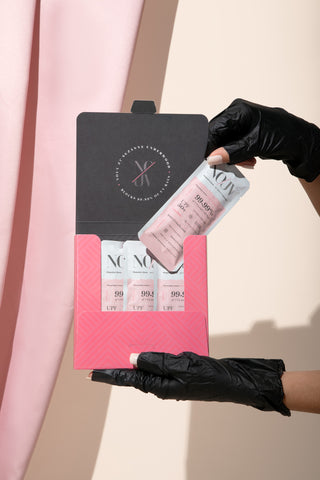
Most people have the same reaction when they hear that NO/UV gloves are made from a nitrile blend: “Can’t I just buy a box of nitrile gloves and cut the tips off?” It sounds logical and on the surface, it feels like you’d get the same protection. But when it comes to UV exposure from gel lamps, not all nitrile is created equal. The material, composition, and consistency matter far more than people realize.
I completely understand the instinct. Nitrile gloves are everywhere. They seem protective. They're associated with safety and hygiene. And if they're good enough for medical procedures, they must be good enough for a gel manicure. Right?
Let me break it all down for you: the science, the specifics, and why the difference between these two gloves could have real long-term consequences for your skin health.
First, Let's Talk About What Nitrile Gloves Are Actually Designed to Do
Nitrile gloves are made from a synthetic rubber compound and they are excellent at what they were designed for. In medical settings, they create a strong barrier against bacteria, viruses, and bodily fluids. In industrial settings, they resist punctures, chemicals, and solvents. They're latex-free, making them safer for people with latex allergies. By every measure of their intended purpose, nitrile gloves are a genuinely impressive piece of protective equipment.
But here's the critical distinction: nitrile gloves were never designed to block UV radiation. They were designed to block pathogens, chemicals, and physical contaminants. UV rays are a fundamentally different type of threat and one that standard nitrile gloves are not engineered to address.
Think of it this way: a raincoat will keep you dry in a downpour, but it's not going to protect you from a sunburn. A tool doesn't fail just because it's asked to do something it was never built for but relying on it in those moments can give you false confidence when real protection is what's needed.
What the Science Says About Nitrile Gloves and UV Rays
This isn't a matter of opinion. It's been studied. Published research on the UV transmittance of laboratory gloves found that nitrile gloves, when tested with a UV radiometer, allowed approximately 0.18% of UVA rays to pass through in their unstretched state. That sounds encouraging until you understand what happens the moment the glove is stretched.
The same research showed that even a 30% stretch which happens naturally when you spread your fingers inside a UV gel nail lamp meaningfully increases UV transmittance. And think about what you're doing during a gel manicure curing cycle: your hand is fully extended, fingers spread apart, glove pulled taut at its thinnest points, positioned directly under a UV or LED nail lamp for minutes at a time.
Add to this a separate finding: UV radiation degrades nitrile glove material over time, actually reducing the tensile strength of the glove on exposure. So the very UV lamp you're trying to protect yourself from is simultaneously breaking down the material of the glove meaning repeated use cycles worsen its protective capacity.
The bottom line: Nitrile gloves are designed for chemical and pathogen protection. They have no UPF rating, no third-party UV testing, and no engineered UV-blocking capability. Using them as UV hand protection during gel nail curing is not a safe substitute. It's an unverified assumption that puts your skin at risk.
What NO/UV Gloves Are Actually Sourced For
NO/UV gloves were sourced for one specific, non-negotiable purpose: protecting the skin on your hands from UV radiation during gel nail curing. Every design decision, every material choice, every specification comes back to that single goal.
Here's how NO/UV gloves differ from regular nitrile gloves across every dimension that matters:
1. Third-Party Tested UV Protection: 99.99% Blocking of UVA and UVB
NO/UV gloves have been independently, third-party tested and verified to block 99.99% of UVA and UVB rays. This is not a marketing claim or a manufacturer's estimate. It's documented, scientific evidence of UV protection efficacy. Nitrile gloves carry no equivalent certification because UV protection is simply not what they are engineered to provide.
When you put on a pair of NO/UV gloves before a gel manicure curing session, you know exactly what level of protection you're receiving. There's no guessing, no variable based on glove color, thickness, or stretch state. That certainty is the entire point.
2. Disposable and Hygienic: Single-Use Protection That Doesn't Compromise
In a salon environment, hygiene is non-negotiable. NO/UV gloves are single-use and disposable, which means each client receives a fresh, uncontaminated pair of gloves for every appointment. There's no sharing, no residual bacteria or product transfer, no degraded protection from repeated washing and wear.
While our gloves are single-use, they are also recyclable because clean beauty principles extend to sustainability. You're not choosing between protecting your skin and protecting the planet.
Nitrile gloves, while disposable in medical and laboratory settings, were never intended or tested for repeated UV lamp exposure cycles. Each time a pair of nitrile gloves is used under a UV nail lamp, the UV radiation is actively degrading the material and if they're reused (as some people do at home), that degradation compounds.
3. Dermatologist-Recommended and Featured in Leading Beauty Media
NO/UV gloves are dermatologist-recommended which means skin health experts, the people who treat UV damage and skin cancer daily, have reviewed and endorsed this product as a meaningful protective measure. We've also been featured in Allure and New Beauty Magazine, and praised by leading nail professionals including Jenny Bui, the nail technician behind Cardi B's iconic sets.
Nitrile gloves have never received dermatological endorsement as UV protection for gel manicures, because that's not a use case they were designed or tested for. Medical endorsement in one context does not transfer to an entirely different application.
Side by Side: NO/UV Gloves vs. Nitrile Gloves at a Glance
Here's the comparison that matters when you're sitting down for a gel manicure:
|
Feature |
NO/UV Gloves |
Nitrile Gloves |
|---|---|---|
|
Purpose |
UV protection during gel nail curing |
Chemical & pathogen barrier (medical/industrial) |
|
UV Protection Rating |
Blocks 99.99% UVA + UVB (third-party tested) |
No UV rating — not designed for UV protection |
|
Third-Party UV Testing |
Yes — independently verified |
No — UV blocking not tested or certified |
|
Dermatologist Recommended |
Yes |
Not for UV protection purposes |
|
Single-Use & Hygienic |
Yes — fresh pair every use |
Yes, but not rated for UV lamp exposure |
|
Recyclable |
Yes |
Standard disposal — typically not recyclable |
|
Designed for UV Nail Lamps |
Yes — this is the entire purpose |
No — not designed for this use case |
The Real Cost of Getting This Wrong
I want to be direct about what's actually at stake. Not to alarm you, but because I think women deserve honest information rather than assumptions.
If you get gel manicures every two weeks and use nitrile gloves as your UV protection believing you're protected when you're actually not. You are accumulating UV damage to your hands with every session. Over a year, that's 26 curing exposures. Over three years, it's 78. Over five years, it's 130.
UVA damage is cumulative and largely invisible until it isn't. Fine lines, hyperpigmentation, age spots, uneven skin tone, and loss of elasticity on the hands are all downstream consequences of repeated UV exposure — and they develop slowly, which makes it easy to underestimate the cause. By the time the damage is visible, years of exposure have already happened.
Research published in Nature Communications confirmed that UV nail lamps cause significant DNA damage and cell mutations in the kind of pattern linked to skin cancer development. This risk is real. And it is preventable.
NO/UV gloves exist precisely because prevention is possible. You don't have to choose between beautiful gel nails and healthy hands. But you do have to make an informed choice about protection and informed choice requires accurate information.
Common Questions About Gel Manicure Gloves, Answered
Can I use nitrile gloves instead of UV-protective gloves for gel manicures?
Nitrile gloves are not designed or tested for UV protection during gel nail curing. They have no UPF rating, are degraded by UV radiation, and are not compatible with gel manicure applications because they cover the fingertips. For effective UV protection during gel manicures, you need purpose-built UV protective manicure gloves like NO/UV, which are third-party tested to block 99.99% of UVA and UVB rays.
What gloves should I wear for gel nails?
The right glove for gel manicures is a purpose-built, fingertipless UV protective glove with third-party verified UV blocking. NO/UV gloves are the dermatologist-recommended, science-backed option, independently tested to block 99.99% of UVA and UVB radiation while allowing complete access to fingernails for polishing and curing.
Why are NO/UV gloves disposable instead of reusable?
Disposability is a core part of NO/UV's design philosophy for two important reasons: hygiene and efficacy. In a salon setting, single-use gloves ensure each client receives an uncontaminated pair. From an efficacy standpoint, repeated UV exposure degrades glove materials over time. Single-use gloves guarantee that the protection you receive on your first session is identical to the protection you receive on your fiftieth. Every time, without degradation.
The Right Tool for the Right Job
I built NO/UV because no one else had built the right thing yet. Not because nitrile gloves are bad. They're excellent at what they were designed to do. But they were not designed for this. And in a beauty industry that often prioritizes aesthetics over informed protection, I believed women deserved something that was genuinely purpose-built for their needs.
NO/UV gloves are the result of a commitment to doing this right. Third-party testing, single-use hygiene, recyclable materials, and UV protection you can trust because it's been scientifically verified, not assumed.
Your gel manicure should be the indulgent, confidence-boosting ritual it's meant to be. Not a source of unacknowledged, cumulative risk to your skin. The difference is just knowing which glove to reach for…and why.
Stay polished. Stay protected. The beauty is in the details and so is the protection.