Gel Manicures 101: How to Enjoy Them Safely
Let me be honest with you: I used to be obsessed with my gel manicures. The glossy finish, the chip-free wear, the way they made my hands look pulled together even on my most chaotic days and I was hooked. Like millions of women, getting my nails done was my ritual, my self-care, my non-negotiable.
And then I started asking questions that made my nail tech a little uncomfortable.
What exactly is that UV lamp doing to my skin? How much UV radiation am I actually being exposed to every time I sit under that light? Is repeated UV exposure from gel nail curing lamps safe? Why isn't anyone talking about this?
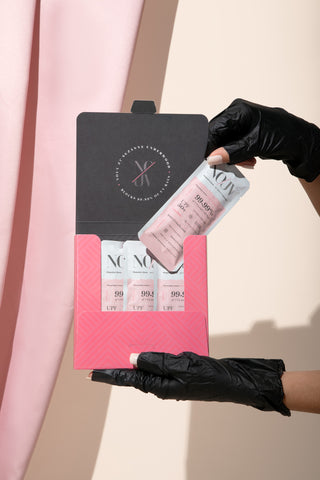
The answers I found were enough to change the course of my career. And they're the reason I created NO/UV, the first dermatologist-recommended, disposable, fingertipless manicure glove that blocks 99.99% of UVA and UVB rays during gel nail curing.
But before I tell you about the solution, let's talk about the full picture because every woman who loves gel manicures deserves to understand exactly what's happening to her skin, and exactly what she can do about it.
What Exactly Is a Gel Manicure and Why Are They So Popular?
Gel manicures have completely transformed the nail industry. Unlike traditional nail polish that can chip within days, gel nails are cured under a UV or LED nail lamp, creating a hard, durable, high-gloss finish that can last two to three weeks without chipping.
There's a reason gel polish has become the gold standard of salon manicures and the fastest-growing segment of the at-home nail care market. The results are beautiful, long-lasting, and genuinely make life easier. Shellac manicures, another popular gel-based nail treatment, work on the same UV-curing principle.
But here's what most salons don't tell you: every time that gel polish cures, your hands are absorbing UV radiation. And the research on what that means for your long-term skin health is something every nail lover needs to know.
The UV Nail Lamp Risk: What the Science Actually Says
UV nail lamps including both traditional UV lamps and newer LED nail lamps emit ultraviolet radiation, specifically UVA rays. UVA rays are the same rays responsible for premature skin aging and skin cancer risk from sun exposure. The difference is that during a gel manicure, your hands are in close, direct contact with these rays at concentrated intensities.
A study published in Nature Communications found that UV nail lamp radiation caused significant DNA damage and cell death. The kind of cellular changes that are linked to skin cancer development. This was true even with short exposures, and the cumulative effect of repeated gel manicure appointments compounds that risk significantly over time.
Here's what UV radiation exposure from gel nail curing can cause:
-
Accelerated skin aging: UVA rays penetrate deeply into the dermis, breaking down collagen and elastin, the proteins that keep skin firm and youthful. Repeated exposure leads to fine lines, wrinkles, and sagging on the hands.
-
Hyperpigmentation and dark spots: UV exposure triggers melanin production, which can result in uneven skin tone, brown spots, and age spots on the hands and fingers.
-
Weakened skin immunity: UV radiation suppresses the skin's local immune response, making the skin more susceptible to infections and reducing its ability to repair itself.
-
Increased skin cancer risk: DNA damage from UVA radiation in skin cells can accumulate over time, potentially leading to mutations associated with skin cancer, including squamous cell carcinoma, which has been reported in cases linked to frequent UV nail lamp use.
I want to be clear: I'm not here to scare you away from gel manicures. I still get them. I love them. The goal is to help you enjoy them safely and that's entirely possible with the right protection.
Are LED Nail Lamps Safer Than UV Nail Lamps?
This is one of the most common questions I get, and the answer might surprise you: not necessarily.
LED nail lamps cure gel polish faster than traditional UV lamps, but they still emit UVA radiation, sometimes at even higher intensities in shorter bursts. The total UV dose may be similar or even higher with certain LED devices. Both types of gel nail curing lamps expose your hands to UVA rays, which means both require protection.
If a salon or at-home kit has switched to LED gel nail lamps and is marketing them as 'safer,' know that safe UV exposure requires protection regardless of lamp type. The answer isn't to avoid UV or LED gel nail lamps. It's to protect your hands while using them.
How to Protect Your Hands During Gel Manicures: A Complete Guide
The good news is that protecting your hands from UV nail lamp exposure is simple, effective, and doesn't require you to give up your gel manicure habit. Here's what actually works:
1. Wear UV-Protective Manicure Gloves: The Gold Standard
This is the most effective solution available and the reason I founded NO/UV. Our disposable, fingertipless manicure gloves are third-party tested to block 99.99% of UVA and UVB rays. They're designed specifically for gel manicures: the open fingertips allow your nails to be polished and cured normally, while the rest of your hand is completely shielded from UV radiation.
Our gloves are single-use and disposable because hygiene matters. At a nail salon, you don't want to be using gloves that have been touched by multiple clients. NO/UV gloves are recyclable and designed with clean beauty values in mind, giving you the highest available UV protection in the most hygienic format possible.
As Jenny Bui, Cardi B's celebrity nail tech, put it: "It's so important to protect your hands during gel manicures and NO/UV allows you to do this safely because they provide not only the highest protection but are also hygienic and recyclable."
2. Apply Broad-Spectrum Sunscreen to Your Hands
If you don't have UV protective manicure gloves on hand, applying a broad-spectrum SPF 30 or higher sunscreen to your hands before UV lamp exposure can offer some protection. Let it absorb fully before the appointment begins. However, sunscreen is not a replacement for purpose -built UV manicure gloves. It degrades with heat and light exposure, and coverage during the curing process is inconsistent.
3. Minimize Curing Time Where Possible
Some gel nail products require longer curing times than others. Ask your nail technician about lower-emission gel formulas or faster-curing gels that reduce total UV exposure time. That said, even short exposures matter, especially over months and years of regular gel manicure appointments.
4. Moisturize and Care for Your Hands After Gel Removal
Gel polish removal, whether with acetone soaking or foil wraps, can be drying and damaging to the skin. Follow every gel removal with a deeply nourishing hand cream or oil to restore moisture and support your skin's barrier function. Keeping the skin healthy and hydrated helps it better withstand environmental stressors, including UV exposure.
The At-Home Gel Manicure Boom: What You Need to Know
The at-home gel nail kit market has exploded in recent years, and I completely understand the appeal. Doing your own gel manicure at home is cost-effective, convenient, and honestly kind of fun. But it also means more frequent UV lamp exposure, often with less awareness of the risks involved.
If you're doing DIY gel manicures at home with a UV or LED nail lamp, the same protection principles apply. Wearing UV-protective fingertipless gloves every single time you cure your gel nails is the smartest investment you can make in your long-term skin health.
Because here's the math: if you're doing your nails at home every two weeks, that's 26 UV lamp exposures per year. Over five years, that's 130 curing sessions. The cumulative UV damage adds up in ways that don't become visible until years later and by then, the aging and pigmentation changes are much harder to reverse.
Why I Created NO/UV and Why It Matters
As a Boston-based beauty entrepreneur with a deep focus on clean beauty and proactive skincare, I saw a gap that no one was addressing. Women were being handed UV lamps with no conversation about what was happening to their skin. The nail industry was growing rapidly, but skin safety wasn't keeping pace.
I wanted to create something that didn't ask women to choose between beautiful nails and healthy skin. That's the premise behind NO/UV: you shouldn't have to sacrifice one for the other.
Our gloves are dermatologist-recommended and third-party tested, not just claimed to work, but scientifically proven to block 99.99% of UVA and UVB radiation. They've been featured in Allure and endorsed by leading nail professionals who care as much about their clients' skin health as they do about beautiful results.
We're not just selling a product. We're building a movement around informed, conscious beauty. Where looking good and staying healthy aren't competing priorities.
Gel Manicure Safety: Your Questions Answered
Are gel manicures safe?
Gel manicures are safe when you protect your skin from UV radiation during the curing process. The gel polish itself is not the issue. It's the UV lamp exposure that carries risk. With the right UV protection (like NO/UV fingertipless manicure gloves), you can safely enjoy gel manicures without concern.
How much UV exposure do you get from a gel manicure?
The amount varies depending on the lamp type, gel formula, and curing time but even a few minutes of direct UV exposure to the hands carries cumulative risk over months and years of appointments. Studies have confirmed measurable DNA damage from UV nail lamp exposure, which is why proactive protection is so important.
How often should I get a gel manicure?
Most gel manicures last two to three weeks, so spacing appointments accordingly gives your nails adequate recovery time. More important than frequency is protection, using UV-blocking manicure gloves every time you cure gel nails makes regular appointments far safer.
Are at-home gel nail kits safe?
At-home gel nail kits are safe with the right precautions. Always wear UV-protective fingertipless gloves when using your home UV or LED nail lamp, follow instructions for proper gel removal, and moisturize your hands and cuticles after each session.
Beauty & Health Belong Together
Here's what I want every woman who loves gel manicures to walk away knowing: you don't have to stop. You don't have to switch to regular polish or accept damaged skin as the price of beautiful nails. You just need the right information and the right protection.
UV exposure from gel nail curing lamps is a real and documented risk. Proactive UV protection during gel manicures is simple, affordable, and genuinely effective. And your hands, which you use, show, and live in every day of your life, deserve the same level of care and intention you give to every other part of your skincare routine.
Stay polished. Stay protected. Your beauty and your health are both in your hands.