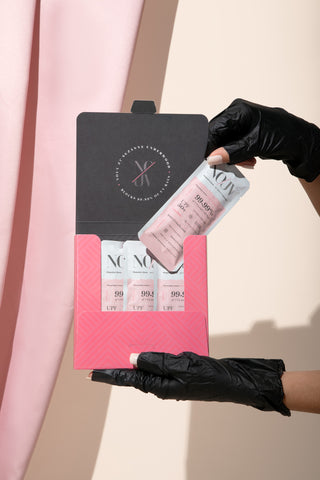
A few months ago, someone messaged me a photo of their hands tucked inside a pair of gardening gloves, fingers poking out through holes they'd cut themselves, sitting under their at home UV lamp. They were proud of the workaround. I understood the impulse completely, but it broke my heart a little too. That's exactly the gap NO/UV was built to close.
Here's the thing about UV protection gloves for nails: not all gloves are created equal, and not all nitrile is created equal either. Most of what's out there wasn't designed, or tested, with a manicure in mind at all.
What UV Actually Does to Your Hands
It helps to understand what you're protecting against in the first place. Gel curing lamps rely on UVA light, and sometimes small amounts of UVB, to activate the photoinitiators that harden gel polish. Dermatology researchers have pointed out that the UV intensity reaching the skin from these lamps is comparable to what you'd get from a tanning bed, and both UVA and UVB radiation are known to promote the formation of cyclobutane pyrimidine dimers, a type of DNA damage linked to skin aging and skin cancer risk over time.
A 2023 study out of UC San Diego, published in Nature Communications, exposed human and mouse cell lines to UV nail dryers and found that after just twenty minutes, twenty to thirty percent of cells had died. After three consecutive twenty minute sessions, that number climbed to sixty five to seventy percent. The FDA has classified UV nail lamps as low risk, and researchers are careful to note that risk isn't the same as no risk. But the pattern is consistent: repeated, close range UV exposure adds up, and the backs of your hands take the brunt of it, session after session.
That's not a reason to give up gel manicures. It's a reason to take the protection step as seriously as the polish itself.
Why Nitrile, and Why Not All Nitrile Is the Same
Nitrile is the right starting material for this job. It's durable, it holds its shape against repeated use, and it's the standard glove material for anyone working around UV curable products for a reason. But here's what most people don't know: nitrile's ability to block UV light is not a given property of the material. It's a variable one.
Research on nitrile glove transmittance has found that UV blocking can differ significantly between gloves of the same thickness, and that thickness alone doesn't reliably predict how much light gets through. Manufacturing quality, pigment, and formulation all play a role, which means two nitrile gloves that look identical on a shelf can perform very differently under a lamp. Standard nitrile gloves, the kind made for medical or industrial use, are built and tested as a barrier against chemicals and punctures. UV blocking was never the design goal, and it's rarely tested for at all.
That gap is exactly why we don't treat our nitrile as an assumption. NO/UV gloves are made from nitrile that is third party tested specifically to confirm its light blocking strength, not estimated from thickness or borrowed from a spec sheet built for a different purpose. The result is gloves that block 99.99 percent of damaging UVA and UVB rays, verified, not guessed at.
Why Nails Need Something Built on Purpose
This is where a fingertipless UV glove earns its keep. The design isn't a stylistic choice. It's the entire point. Your fingertips stay free so you can polish, file, and cure with full dexterity, while the rest of your hand, the part that actually sits under the lamp the longest, stays shielded by nitrile that's been proven to do the job.
It's a small design detail solving a real, measurable problem, and it's the reason at home gel manicures can feel just as safe as a trip to the salon, without asking you to sacrifice the fine motor control the process requires.
The NO/UV Difference
I didn't start this brand because I thought gloves were an interesting business. I started it because I was doing my own gel manicures at home, watching the tops of my hands change over time, and realizing that nobody had actually built something for this specific moment, tested to prove it worked, rather than assumed to.
NO/UV gloves are cut for salon quality nail care from the start. Fingertipless by design, fitted to move naturally through a full gel routine, and made from a nitrile blend that's independently, third party tested to confirm 99.99 percent UVA and UVB blocking, rather than borrowed from an unrelated use case and hoped to work. That's the differentiator. Not an added feature, but the whole premise the glove was built around, and the reason we can say with confidence, not marketing language, that it's the strongest UV blocking nitrile built for manicure use on the market today.
What to Look For, Whichever Glove You Choose
If you're comparing options, a few questions are worth asking. Does the glove leave your fingertips free enough to actually do your nails? Has the blocking ability actually been tested, or is it assumed from the material alone? Does it fit snugly enough to stay in place through a full cure cycle?
If the answer to any of those is no, you're probably looking at a glove that was designed for something else and repurposed for nail care, with UV protection as a guess rather than a guarantee. It might be better than nothing. But better than nothing was never really the goal, not when your skin is what's on the line.
Protecting your hands shouldn't feel like a workaround, and it shouldn't be a guess either. It should feel like part of the routine, backed by real testing, built in rather than bolted on. That's what we set out to make.
Here's to hands that get to do beautiful work and stay protected while they do it.
XOXO: Suzanne